Ultra-High-Sensitivity Magnetic Detection
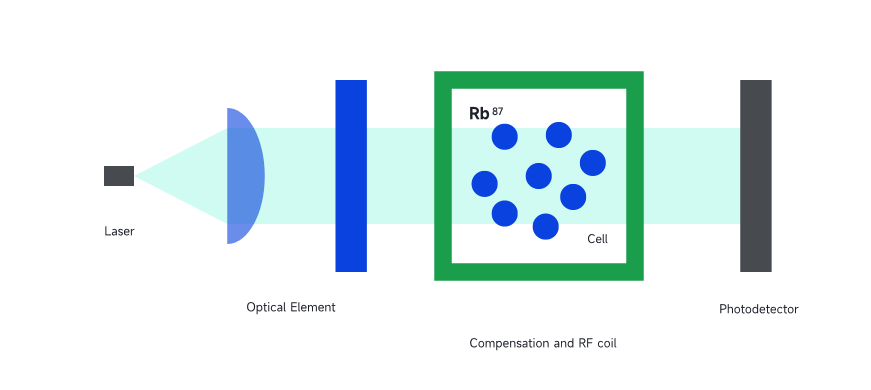
In a near-zero magnetic field environment, a circularly polarized laser (pump beam) is used to "pump" all atoms in the gas cell to the same quantum state, aligning their spin directions (polarization). At this point, the atoms' absorption of the laser is minimized, rendering the gas cell highly transparent and maximizing the transmitted light intensity. When an extremely weak target magnetic field is present, it disrupts the atomic polarization, causing the atoms to redistribute to different energy levels. This increases the atoms' absorption of the laser, reduces the transparency of the gas cell, and weakens the transmitted light intensity. By precisely monitoring the intensity changes of this transmitted laser with high signal-to-noise ratio processing circuits, we achieve highly sensitive measurement of weak vector magnetic fields. This principle does not directly "read" the atomic precession but infers the magnetic field by monitoring changes in the overall polarization of the atomic ensemble, enabling unparalleled sensitivity near the zero-field point.
Ultra-Wide-Dyn-Range Mag Detection Principle
A linearly polarized pump laser polarizes the spins of atoms in the gas cell, preparing a macroscopic magnetization vector (Mz). A coil applies a radiofrequency (RF) magnetic field with precisely controllable frequency to the gas cell. When the frequency of the RF magnetic field exactly matches the Larmor precession frequency of the atoms in the geomagnetic field, magnetic resonance occurs. At this point, the atoms absorb energy from the RF field, disturbing their spin orientation and causing periodic changes in their absorption rate of the pump laser. By monitoring the modulation signals of the transmitted light intensity, the resonance point is accurately determined. The electronic system employs closed-loop feedback to automatically scan and lock onto this resonance frequency (f). Based on the formula |B| = f / γ (where γ is the gyromagnetic ratio of the atoms, a fixed physical constant), the absolute value of the total ambient magnetic field is directly calculated. By locking onto the inherent resonance frequency of the atoms, this method inherently achieves absolute accuracy, exceptional long-term stability, and strong anti-interference capabilities, requiring no calibration.
Navigation and Positioning